
Juniper Mist Wi-Fi Access Points
Wi-Fi 7 down to Wi-Fi 6E access point hardware built for every space: office floors, wards, warehouses, and rugged outdoor edges.
Overview
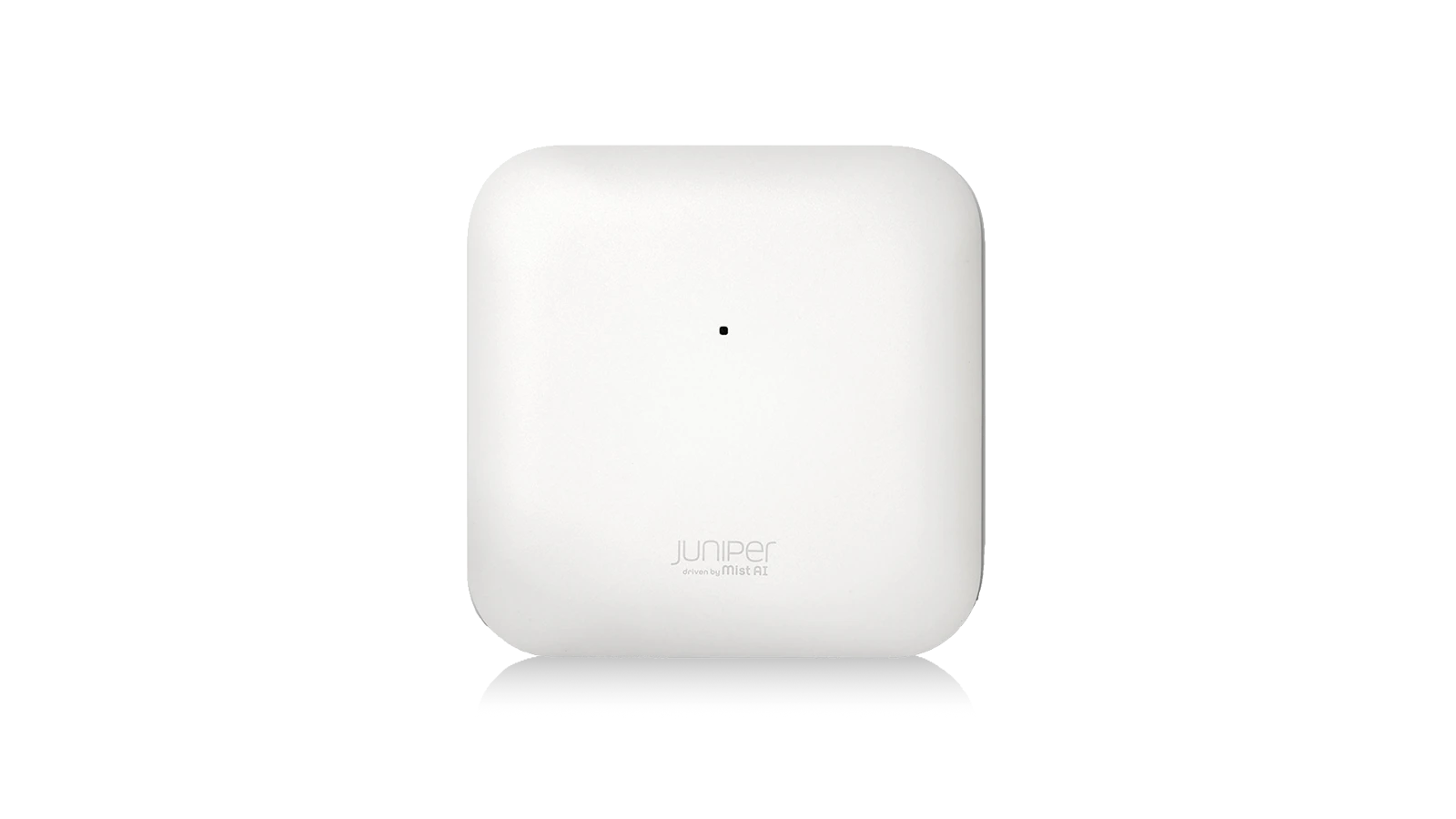
Juniper Mist access points are the radio hardware in the Juniper Mist AI-Native portfolio: physical APs you mount on ceilings, walls, or outdoor poles that stream telemetry into the Mist cloud so Marvis AI has real data to work with. The current lineup runs from the four-radio AP47 flagship (Wi-Fi 7, up to 11,528 Mbps in 6 GHz) down through the AP37/AP36 performance tier, Wi-Fi 6E models like AP45/AP34/AP24, the rugged outdoor AP66 and AP64, and Wi-Fi 6 holdovers like AP43, plus purpose-built units like the AP17 wall-plate AP and AP27/AP27E for warehouses and freezer penetrations.
The hardware decision that actually matters is radio architecture and power draw, not just the Wi-Fi generation on the box. Every flagship and performance-tier model (AP47, AP45, AP37, AP36) dedicates a fourth radio purely to scanning: it never serves clients, it just feeds RF and security telemetry to the cloud around the clock. That fourth radio is also why those models need 802.3bt PoE, roughly 25 to 29 watts at the powered device, to run all radios at full 4x4 MIMO. Lighter models like the AP24 and AP64 run full function on plain 802.3af (13W), which changes your switch port and PoE budget planning more than any spec sheet headline does.
As an authorized HPE Juniper Networking partner, Uniqcli sources TAA-compliant AP configurations for GPC, SAP, FAR, and GSA eBuy buyers, and we size the PoE budget, mounting hardware, and Wi-Fi Assurance licensing alongside the AP count so a hardware refresh does not stall on a switch that cannot deliver 802.3bt to half your closets.
Why Juniper Mist Wi-Fi Access Points
Picking the wrong AP for a space costs more than a bad Wi-Fi generation choice: it is a PoE budget problem, a mounting problem, or an IP-rating problem that shows up during install, not during the RFP. A four-radio AP47 on 802.3at power silently drops to reduced-feature mode instead of failing loudly. An indoor AP-grade enclosure in a loading dock or freezer corridor will not survive a season. Getting radio count, PoE class, and environmental rating right before the purchase order goes out avoids truck rolls, mid-project switch upgrades, and RMA cycles that eat the schedule margin on federal and healthcare deployments where downtime windows are scarce.
AP47: the four-radio Wi-Fi 7 flagship
Three 4x4:4 802.11be data radios plus a dedicated tri-band scanning radio, delivering up to 11,528 Mbps in 6 GHz and 5,764 Mbps in 5 GHz for the densest indoor enterprise floors.
AP37/AP36 bring Wi-Fi 7 to mainstream budgets
Same tri-band-plus-scanning-radio architecture as the AP47 at a lower price point, with dual 802.15.4 IoT radios for vBLE, Thread, Zigbee, and Matter concurrently.
AP66/AP66D rated IP67 for outdoor and harsh indoor
A sealed, weatherproof enclosure with dual IoT radios, onboard BLE 5.4, and multi-constellation GNSS/GPS, built for loading docks, campus quads, and manufacturing floors exposed to dust or moisture.
AP64: full function on the lightest PoE class
Juniper's smallest ruggedized AP runs full Wi-Fi 6E performance on plain 802.3af (13W), the same class as the entry AP24, making it the easiest AP in the lineup to power over legacy switch infrastructure.
AP24/AP34/AP45 cover Wi-Fi 6E at three power tiers
AP24 needs only 802.3af, AP34 needs 802.3at, and the flagship AP45 (16-element vBLE array, four 4x4 802.11ax radios) needs the most power of the three, letting you match AP tier to what your switch closets can actually deliver.
Purpose-built form factors beyond the standard ceiling mount
The AP17 wall-plate AP targets hotel rooms, dorms, and MDUs with three client radios plus a scanning radio in a compact chassis, while the AP27E adds external antennas for warehouse racking and freezer/cooler wall penetrations.
What it does
Match radio count to client density, not just Wi-Fi generation
A four-radio AP47 or AP37/AP36 dedicates its fourth radio purely to scanning, so client-serving capacity does not degrade as RF and security telemetry keeps flowing to the cloud.
Plan PoE budgets before the switch order goes out
The lineup spans 802.3af (13W) on AP24/AP64 to 802.3bt (up to 29.3W) on AP47/AP36/AP37, so the AP tier you choose determines whether your existing switches can power it at full function or need a PoE upgrade.
Deploy accurate location services without battery beacons
Patented vBLE antenna arrays on AP45, AP43, and AP47 (up to 16 elements) deliver 1-3 meter location accuracy for asset tracking and wayfinding, cloud-controlled with no beacon batteries to replace.
Cover outdoor and harsh environments without a separate vendor
The IP67-rated AP66/AP66D and ruggedized AP64 extend the same Mist cloud management to loading docks, quads, and manufacturing floors that indoor APs cannot survive.
Fit specialized spaces with purpose-built form factors
The AP17 wall-plate design and AP27E external-antenna variant solve in-room hospitality density and warehouse/freezer coverage that a standard ceiling-mount AP cannot address.
Concurrently support IoT protocols on one radio set
Dual 802.15.4 radios on AP36, AP37, and AP66 run vBLE, Thread, Zigbee, and Matter concurrently, consolidating IoT connectivity onto the same AP instead of a separate gateway.
The Juniper Mist Wi-Fi Access Points lineup
Juniper AP47
The highest-density indoor Wi-Fi 7 AP in the lineup, for enterprise floors and federal facilities with 802.3bt already budgeted.
Four-radio Wi-Fi 7 (802.11be) flagship: three 4x4:4 data radios plus a dedicated tri-band scanning radio; up to 11,528 Mbps (6 GHz); dual multi-gig PoE-in ports; requires 802.3bt (~29W) for full function.
Juniper AP37 / AP36
Mainstream Wi-Fi 7 access for offices, schools, and clinics moving to 6 GHz without the AP47's price point.
Tri-band Wi-Fi 7 with a dedicated fourth scanning radio; AP36 delivers 11,528 Mbps (6 GHz 4x4:4); dual 802.15.4 IoT radios; needs 802.3bt (29.3W) for full 4x4 on all three radios, drops to 2x2 on 802.3at.
Juniper AP66 / AP66D
Campus quads, covered walkways, loading docks, and manufacturing floors exposed to dust or moisture; AP66D adds software-controlled directional antennas.
IP67-rated ruggedized tri-band Wi-Fi 7 (four-radio, 2x2:2 data plus scanning), dual 802.15.4 IoT radios, onboard BLE 5.4, multi-constellation GNSS/GPS; 802.3at (25.5W) for full function.
Juniper AP45
6 GHz capacity and precision location services for enterprises not yet standardizing on Wi-Fi 7.
Wi-Fi 6E flagship, four 802.11ax radios (4x4 MIMO) with one dedicated to scanning/RRM; up to 4800 Mbps (6 GHz); 16-element vBLE array for 1-3m location accuracy; PoE dynamic up to 29.3W.
Juniper AP34 / AP24
Budget-tier 6 GHz coverage where lower PoE class matters more than the top radio count.
Wi-Fi 6E tri-band, quad-radio (AP34) or tri-radio dual-band-concurrent (AP24); 2400 Mbps (6 GHz); AP34 needs 802.3at (20.9W), AP24 runs full function on plain 802.3af (13W).
Juniper AP64
Compact rugged coverage for tight spaces and legacy switches that can't deliver higher PoE classes.
Smallest ruggedized AP in the lineup, Wi-Fi 6E tri-band with 2 client-serving radios (2x2) plus a dedicated sensor radio; full function on 802.3af (13W); 8.5 x 8.5 x 2.5 in enclosure.
Juniper AP43
Proven Wi-Fi 6 coverage with location services for sites not moving to 6E or Wi-Fi 7 yet.
Wi-Fi 6 (802.11ax) tri-radio 4x4, 2400 Mbps (5 GHz), no 6 GHz band; 16-element vBLE array; third radio doubles as sensor/spectrum monitor; needs 802.3bt (25.5W) for full function.
Juniper AP27 / AP27E / AP17
Specialized form factors for warehouses, cold storage, hotels, dorms, and multi-dwelling units where a ceiling-mount AP doesn't fit the space.
AP27: tri-band concurrent Wi-Fi 7 with a dedicated fourth radio for always-on security/RF monitoring; AP27E adds external antennas for warehouse and freezer/cooler penetrations; AP17 is a wall-plate Wi-Fi 7 AP (three 2x2:2 radios plus scanning) for in-room high-density spaces.
At a glance
- Radio architecture (AP47/AP45/AP37/AP36)
- Three 4x4 data-serving radios plus a dedicated fourth radio for continuous scanning and RF/security telemetry
- AP47 max data rates
- 11,528 Mbps in 6 GHz, 5,764 Mbps in 5 GHz (four-radio, 802.11be)
- AP66/AP66D max data rates
- 5.8 Gbps in 6 GHz, 2.9 Gbps in 5 GHz, 688 Mbps in 2.4 GHz (tri-band 2x2:2 plus scanning radio)
- PoE class by tier
- 802.3af (13W) on AP24/AP64; 802.3at (~20-25.5W) on AP34/AP66/AP43; 802.3bt (~25.5-29.3W) required for full 4x4 performance on AP36/AP37/AP45/AP47
- IoT and location radios
- Dual 802.15.4 radios (Thread/Zigbee/Matter) on performance-tier and rugged models; patented vBLE antenna arrays (up to 16 elements) on AP45/AP43/AP47 for 1-3 meter location accuracy
- Outdoor rating
- AP66/AP66D enclosure rated IP67; AP64 ruggedized for indoor/outdoor with a dedicated third sensor radio
- Ethernet uplinks
- Multi-gigabit RJ45 (100/1000/2500/5000/10000BASE-T) on flagship and rugged models; AP47 carries dual multi-gig ports with PoE-in on both for redundancy
- Specialized form factors
- AP17 wall-plate AP for in-room high-density (hotels, dorms, MDUs); AP27E with external antennas for warehouse racking and freezer/cooler penetrations; AP-723H dual-platform hardware for Mist AI or Aruba Central
How to buy Juniper Mist Wi-Fi Access Points
Juniper Mist access points are purchased as hardware SKUs (indoor, outdoor, and specialty form factors) alongside a Juniper Mist cloud subscription tier that activates Wi-Fi Assurance, Marvis AI, and the management dashboard. Uniqcli quotes the AP hardware, the matching subscription term, and any PoE or mounting accessories together so the bill of materials arrives complete.
Per-AP hardware purchase
Buy AP47, AP37/AP36, AP66, AP45, AP34/AP24, AP64, AP43, AP27/AP27E, or AP17 units individually or in bulk, sized to your floor plan and PoE budget.
Mist cloud subscription tiers
Wi-Fi Assurance and higher tiers are licensed per AP on a subscription term; we align the license term to your hardware refresh cycle so nothing lapses mid-deployment.
GPC, SAP, FAR, and GSA eBuy contract vehicles
Federal and public-sector buyers can route AP hardware and licensing through GPC, SAP, FAR-based orders, or GSA eBuy; tell us your preferred vehicle and we confirm current availability and lead time.
Government Purchase Card (GPC) orders
Smaller AP orders, spare units, and accessory purchases can be processed via GPC for agencies and departments that need a fast, low-friction transaction.
Refresh and trade-in support
Migrating from an older Mist AP generation or a competing vendor's hardware, we help plan a phased swap that keeps Wi-Fi Assurance SLEs intact across the transition.
Where it fits
Frequently asked
Which Juniper Mist AP should I use for high-density indoor Wi-Fi 7?
Start with the AP47, the four-radio flagship with three 4x4:4 data radios and a dedicated scanning radio, rated up to 11,528 Mbps in 6 GHz. If budget is tighter, the AP37 or AP36 use the same radio architecture at a lower price point. Both need 802.3bt PoE (about 29W) for full 4x4 performance, so confirm your switch can deliver that class before ordering.
What PoE class do these access points actually need?
It varies sharply by tier. The AP24 and AP64 run full function on plain 802.3af (13W), the lightest class in the lineup. The AP34 and AP66 need 802.3at (roughly 20-25.5W). The AP36, AP37, AP45, and AP47 need 802.3bt (25.5-29.3W) to run all radios at full 4x4 MIMO; on lower PoE classes several of these drop to reduced-radio modes instead of failing outright. We size the PoE budget against your switch inventory before the AP order goes out.
Which model is rated for outdoor deployment?
The AP66 and AP66D carry an IP67-rated enclosure built for outdoor and harsh indoor environments like loading docks, campus quads, and manufacturing floors. The AP66D adds software-controlled directional antennas where the AP66 uses flexible omnidirectional coverage. The AP64 is also ruggedized for indoor/outdoor use in a smaller, Wi-Fi 6E footprint.
Do I need a special AP for warehouses or cold storage?
The AP27E variant adds external antennas specifically for warehouse racking and freezer/cooler wall penetrations, where signal has to pass through insulated barriers that a standard internal-antenna AP struggles with. Tell us your floor plan and we can confirm whether AP27E, AP66, or a standard model fits better.
Can Uniqcli source TAA-compliant Juniper Mist access point configurations?
Yes. As an authorized HPE Juniper Networking partner, we source TAA-compliant AP configurations for federal and public-sector buyers. Tell us the models and quantities and we confirm the compliant build and lead time for your requirement.
Are these access points available on GPC, SAP, FAR, or GPC direct?
Juniper Mist access points are available to public-sector buyers through vehicles including GPC, SAP, FAR-based orders, and GSA eBuy. Share your preferred vehicle and we route the quote accordingly and confirm current availability.
What's the difference between the AP45 and the newer AP34/AP24 for 6 GHz coverage?
All three are Wi-Fi 6E, but they differ in radio count, vBLE hardware, and PoE class. The AP45 is the flagship with four 802.11ax radios (one dedicated to scanning), a 16-element vBLE array for 1-3 meter location accuracy, and the highest PoE draw of the three. The AP34 drops to a quad-radio design without the flagship vBLE array and needs 802.3at. The AP24 is the lightest, running full function on plain 802.3af, making it the easiest to deploy over existing switch infrastructure.
Where do I get a quote for a specific AP model and quantity?
Use our quote request form with your model list, site count, and PoE class per closet, or start a bill of materials in our BOM tool if you're combining APs with switches and licensing. We'll confirm lead time, TAA status if needed, and the matching Mist subscription tier before you commit.
Works with
Mist access point hardware pairs with the rest of the Juniper and Aruba Networking stack Uniqcli sources, so wired, wireless, and operations tooling stay under compatible management.
Compare before you buy
All comparisonsRelated in Networking

Aruba Access Points & Wi-Fi
The full Aruba AP portfolio, from entry Wi-Fi 6 to flagship Wi-Fi 7, matched to your density, environment, and budget

Aruba Central
AI-native cloud management for the whole network, with agentic AIOps and a GreenLake Copilot that reasons and acts

Aruba ClearPass Policy Manager
The multivendor NAC engine behind Aruba's Zero Trust access, hardware, virtual, or GreenLake, sized from 100 to 100,000 endpoints
Shop Juniper Mist Wi-Fi Access Points in the catalog
See all results
Juniper Mounting Bracket for Wireless Access Point
APBRWP1
Juniper Mounting Bracket for Wireless Access Point
Juniper Mounting Bracket for Wireless Access Point
APOUTBR-KIT
Juniper Mounting Bracket for Wireless Access Point
Juniper Mounting Bracket for Wireless Access Point
APBR-U
Juniper Mounting Bracket for Wireless Access Point
Juniper Wireless Access Point (Wi-Fi) MPIM
SRX-MP-WLAN-US
Juniper Wireless Access Point (Wi-Fi) MPIM
Juniper Wireless Access Point (Wi-Fi) MPIM
SRX-MP-WLAN-WW
Juniper Wireless Access Point (Wi-Fi) MPIM
Juniper Wireless Access Point (Wi-Fi) MPIM
SRX-MP-WLAN-IL
Juniper Wireless Access Point (Wi-Fi) MPIM
Juniper Mounting Bracket for Wireless Access Point
BT11BR1
Juniper Mounting Bracket for Wireless Access Point
Juniper Mounting Bracket for Wireless Access Point
APOUTBR1
Juniper Mounting Bracket for Wireless Access Point
Build your HPE bill of materials.
Send us the requirement, the project, or an existing quote to beat. We come back with a validated, TAA-compliant HPE configuration and a real price, often below list.
connect [at] getuniqcli.com · Chicago, IL