
NVIDIA GB300 NVL72 by HPE, Explained
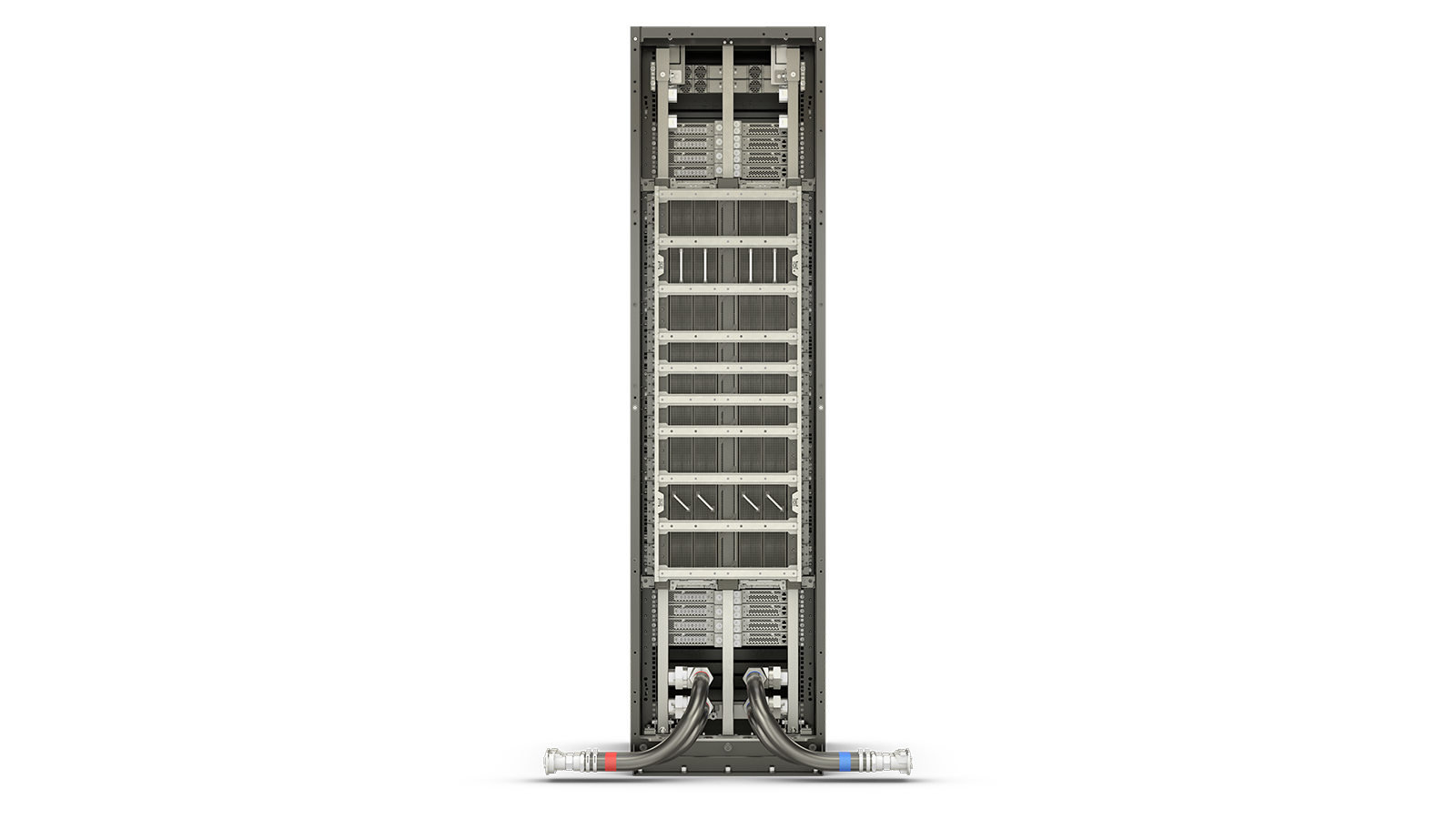
The AI infrastructure landscape crossed a significant threshold when NVIDIA announced the GB300 NVL72, the rack-scale successor to the widely deployed GB200 NVL72. Built on the Blackwell Ultra GPU architecture, the GB300 NVL72 is not an incremental refresh — it is a ground-up reconfiguration of what a single rack can accomplish for trillion-parameter AI workloads. HPE, as one of NVIDIA's premier computing partners, offers the GB300 NVL72 as an integrated rack-scale system with HPE's own liquid-cooling engineering, management software, and enterprise services layered on top.
For federal agencies, SLED institutions, healthcare systems, and enterprise IT teams evaluating their next AI infrastructure investment, the GB300 NVL72 by HPE represents one of the most capable on-premises AI platforms available today. This post breaks down the architecture, performance characteristics, ecosystem integrations, and practical deployment considerations that buyers need to understand before engaging a vendor.
What Is the NVIDIA GB300 NVL72?
The NVIDIA GB300 NVL72 is a rack-scale AI computing platform that integrates 72 NVIDIA Blackwell Ultra GPUs and 36 Arm-based NVIDIA Grace CPUs into a single fully interconnected unit. The "NVL72" designation refers to the NVLink rack domain — all 72 GPUs communicate at ultra-high bandwidth through NVIDIA's fifth-generation NVLink fabric, effectively making the entire rack behave as one logical accelerated computing node.
Key architectural building blocks:
- 18 compute trays, each housing 2 GB300 Grace-Blackwell boards
- 72 Blackwell Ultra GPUs (GB300 die) and 36 NVIDIA Grace Arm CPUs per rack
- Fifth-generation NVLink providing 1.8 TB/s of bidirectional GPU-to-GPU bandwidth (900 GB/s per direction) and 130 TB/s of aggregate NVLink bandwidth across the full rack domain
- HBM3e memory delivering 8 TB/s per GPU with 288 GB of HBM3e capacity per GPU — yielding approximately 20.7 TB of total GPU memory across the rack
- Up to 40 TB of coherent fast memory at rack scale when combining GPU HBM3e with Grace CPU LPDDR5X memory
- 1.1 EXAFLOPS of FP4 AI compute in a single rack
The system's power envelope is 132 kW nominal TDP, with an electrical design power peak of approximately 155 kW. That power density demands direct liquid cooling, which HPE delivers natively.
Blackwell Ultra vs. Blackwell: What Actually Changed
Buyers who already evaluated the GB200 NVL72 will rightly ask whether the GB300 upgrade is meaningful or marginal. The answer is meaningful — particularly for inference-heavy and long-context reasoning workloads.
| Specification | GB200 NVL72 | GB300 NVL72 |
|---|---|---|
| GPU Die | Blackwell (B200) | Blackwell Ultra (B300) |
| HBM per GPU | ~192 GB HBM3e | 288 GB HBM3e |
| GPU Memory BW | ~8 TB/s | 8 TB/s |
| Dense FP4 TFLOPS | ~9 PFLOPS/GPU | ~15 PFLOPS/GPU |
| FP8 TFLOPS | ~4.5 PFLOPS/GPU | ~5 PFLOPS/GPU |
| Attention Performance | Baseline | 2x acceleration |
| CUDA Cores | 18,432 | 20,448 |
| NVLink Generation | 5th gen | 5th gen |
| Rack-level FP4 | ~0.7 EXAFLOPS | 1.1 EXAFLOPS |
| Total GPU Memory | ~14 TB | ~20.7 TB |
The most operationally significant upgrades are the 50% increase in HBM3e capacity per GPU (192 GB to 288 GB) and the 2x improvement in attention processing throughput. Together, these changes translate directly into improved handling of long-context workloads — reasoning models, AI coding agents, and retrieval-augmented generation pipelines that process inputs measured in hundreds of thousands of tokens. NVIDIA's own performance data indicates that for 128,000-token input workloads, the GB300 NVL72 achieves up to 1.5x lower cost per output token compared to the GB200 NVL72.
The HPE Layer: What HPE Adds to the NVL72
Purchasing the GB300 NVL72 through HPE is not the same as purchasing raw NVIDIA hardware. HPE integrates the NVIDIA rack platform with its own engineering, software, and services portfolio. Key HPE-specific contributions include:
Direct Liquid Cooling (DLC) and thermal management. The GB300 NVL72 by HPE uses cold plates on CPUs and GPUs, capturing roughly 90% of rack heat via the liquid loop and only 10% via residual air. HPE brings its own rack manifold hardware — the HPE Rack Manifold for NVIDIA GB300 NVL72 — to manage coolant distribution at the rack level. This is not an afterthought; proper thermal architecture is a prerequisite for sustaining peak performance over extended workload runs.
HPE iLO (Integrated Lights-Out) management. HPE iLO provides silicon root-of-trust security, firmware lifecycle management, and out-of-band server administration. The current HPE iLO 7 platform includes post-quantum cryptography and meets FIPS 140-3 Level 3 certification requirements — a critical consideration for federal and regulated-industry buyers who must demonstrate firmware integrity.
HPE OpsRamp observability. HPE has extended its OpsRamp AIOps platform to support GPU cluster monitoring, providing full-stack observability across training and inference workloads running on large NVIDIA accelerated clusters. OpsRamp's GPU optimization capabilities allow operations teams to monitor GPU utilization, thermal states, and workload performance alongside the broader server, network, and storage estate.
Redfish API support. The GB300 NVL72 by HPE conforms to DMTF Redfish standards, enabling consistent management automation for configuration, monitoring, and maintenance tasks through modern, standards-based APIs.
HPE Pointnext Services. HPE's professional services and support organization provides deployment engineering, site readiness assessment (liquid cooling, power, networking), and ongoing support contracts — which are particularly valuable for organizations deploying rack-scale DLC infrastructure for the first time.
AI Factory Blueprints for Government and Enterprise
HPE has formalized its GB300 NVL72 offering within a broader Secure AI Factory approach targeting government and regulated-industry buyers. Rather than selling compute nodes in isolation, HPE packages the GB300 NVL72 alongside complementary infrastructure into repeatable, validated reference architectures:
- NVIDIA GB300 NVL72 by HPE as the core compute tier
- HPE ProLiant Compute servers with NVIDIA Blackwell GPUs for hybrid workloads requiring more flexible node configurations
- HPE Private Cloud AI for organizations that need on-premises AI infrastructure with a cloud-like operating model, delivered as-a-service via HPE GreenLake
- NVIDIA InfiniBand or Ethernet networking for the scale-out fabric connecting multiple NVL72 racks or integrating with broader data center networks
- HPE Aruba Networking for campus, edge, and data center network connectivity
This blueprint approach is significant for federal and SLED buyers because it reduces procurement complexity, provides a single vendor-accountable stack, and makes it easier to satisfy compliance requirements for firmware provenance, supply chain security, and data residency.
Target Workloads: Where GB300 NVL72 Delivers
The GB300 NVL72's architecture optimizes for specific workload profiles. Buyers should validate fit against their actual workloads rather than treating raw EXAFLOPS as a universal proxy for value.
High-fit workloads:
- Large language model training for models exceeding 1 trillion parameters, where 20+ TB of fast pooled GPU memory eliminates the fragmentation penalties of smaller node counts
- AI reasoning and long-context inference (legal document analysis, scientific literature review, code reasoning agents) where the 2x attention throughput gain directly reduces time-to-first-token and cost-per-query
- Agentic AI pipelines that run multi-step reasoning chains requiring sustained high-throughput inference
- Video AI and multimodal inference where GB300 NVL72's combined compute and memory bandwidth supports real-time processing at scale
- Life sciences and drug discovery workloads (molecular dynamics, protein structure prediction) that exhibit dense numerical compute patterns matching the FP4/FP8 performance envelope
- Cybersecurity analytics and anomaly detection at petabyte scale, relevant for federal cyber programs
Consider alternatives for:
- Smaller inference workloads that do not saturate a fraction of an NVL72 rack — purpose-built inference nodes or HPE ProLiant servers with single or dual NVIDIA GPUs may offer better economics
- Air-cooled data centers without liquid cooling infrastructure, where facility upgrades may outweigh compute benefits in the near term
Deployment and Facility Prerequisites
The GB300 NVL72 is not a drop-in upgrade for most existing data centers. Organizations evaluating this platform should assess the following before finalizing procurement:
- Power infrastructure: The rack requires up to 155 kW peak draw. A single rack demands dedicated PDU and electrical circuit capacity that many legacy data centers do not have without significant upgrades.
- Liquid cooling readiness: Direct liquid cooling requires facility-side chilled water or coolant distribution units (CDUs) rated for the rack's thermal output. HPE's rack manifold integrates with standard data center CDU deployments but requires a qualified site assessment.
- Floor loading: A fully populated GB300 NVL72 rack is substantially heavier than standard compute racks; structural floor load capacity must be verified.
- Networking fabric: Scale-out deployments connecting multiple NVL72 racks require NVIDIA InfiniBand or high-speed Ethernet switching with appropriate port density and cable plant planning.
HPE Pointnext Services provides site readiness assessments that evaluate all of these dimensions, which is one concrete reason to engage HPE rather than attempting to source and integrate the hardware independently.
How GB300 NVL72 Fits SLED, Healthcare, and Federal Buyers
Public sector and regulated-industry buyers have requirements that go beyond raw AI performance. The GB300 NVL72 by HPE addresses several of these explicitly:
- Data sovereignty: On-premises deployment keeps training data and model weights within the organization's controlled environment, satisfying requirements that preclude public cloud options for sensitive workloads (classified research, protected health information, law enforcement data).
- FIPS and firmware security: HPE iLO 7's post-quantum cryptography and FIPS 140-3 Level 3 certification provide a defensible firmware security posture for FedRAMP-adjacent and DoD deployments.
- Procurement vehicles: As an authorized HPE partner, Uniqcli can facilitate access through federal and SLED contract vehicles, streamlining the acquisition process for government buyers.
- GreenLake consumption model: Organizations that prefer an OpEx model over capital equipment purchases can deploy GB300 NVL72 capacity through HPE GreenLake, which delivers on-premises infrastructure on a pay-per-use basis — useful for SLED buyers with constrained capital budgets or programs with variable AI compute demand.
- Healthcare AI: Healthcare systems exploring clinical AI (radiology model inference, genomics pipelines, clinical NLP at scale) benefit from on-premises deployment for PHI compliance while gaining the performance headroom to run large, multi-modal clinical models without cloud data transfer constraints.
If you are evaluating the GB300 NVL72 for a specific program or agency, contact Uniqcli to discuss configuration, compliance requirements, and procurement pathway options.
Positioning the GB300 NVL72 in Your AI Infrastructure Roadmap
The GB300 NVL72 occupies the apex of the current NVIDIA compute hierarchy for on-premises AI. It is not the right answer for every use case — but for organizations with a credible roadmap toward trillion-parameter model training, high-throughput agentic inference, or extreme-scale scientific computing, it defines what is achievable in a single rack today.
The decision framework for most buyers comes down to three questions:
- Do your target workloads benefit from pooled GPU memory at 20+ TB? If yes, the NVL72 architecture avoids the cross-node coordination overhead that limits smaller multi-node clusters.
- Can your facility support direct liquid cooling and 130+ kW per rack? If yes, the operational path is clear. If not, quantify the facility investment before comparing total cost to alternatives.
- Do you need the specific performance profile of Blackwell Ultra (long-context inference, attention throughput)? If your workloads are primarily batch training with shorter sequences, the economics of GB200 NVL72 or ProLiant servers with H100/H200 GPUs may remain favorable.
Explore the full NVIDIA GB300 NVL72 by HPE product page for configuration details, or browse our supercomputing catalog to see related AI infrastructure offerings.
For buyers at earlier stages of planning, our AI infrastructure guides cover workload sizing, facility planning, and procurement strategy for organizations building out on-premises AI capacity.
How Uniqcli Helps
Uniqcli is an authorized HPE partner with hands-on experience supporting federal, SLED, healthcare, and enterprise buyers through complex AI infrastructure acquisitions. We help organizations translate workload requirements into validated hardware configurations, identify the right HPE contract vehicles or GreenLake consumption options, and plan the facility and networking infrastructure that surrounds the compute.
Whether you are at the stage of initial feasibility assessment or ready to configure and quote a GB300 NVL72 deployment, our team is here to support the process without vendor pressure or upsell friction.
Request a quote for the NVIDIA GB300 NVL72 by HPE, or contact our team to schedule a technical consultation tailored to your organization's AI infrastructure goals.