
"Building AI Inference Infrastructure on HPE ProLiant: GPU Server Configurations That Scale"
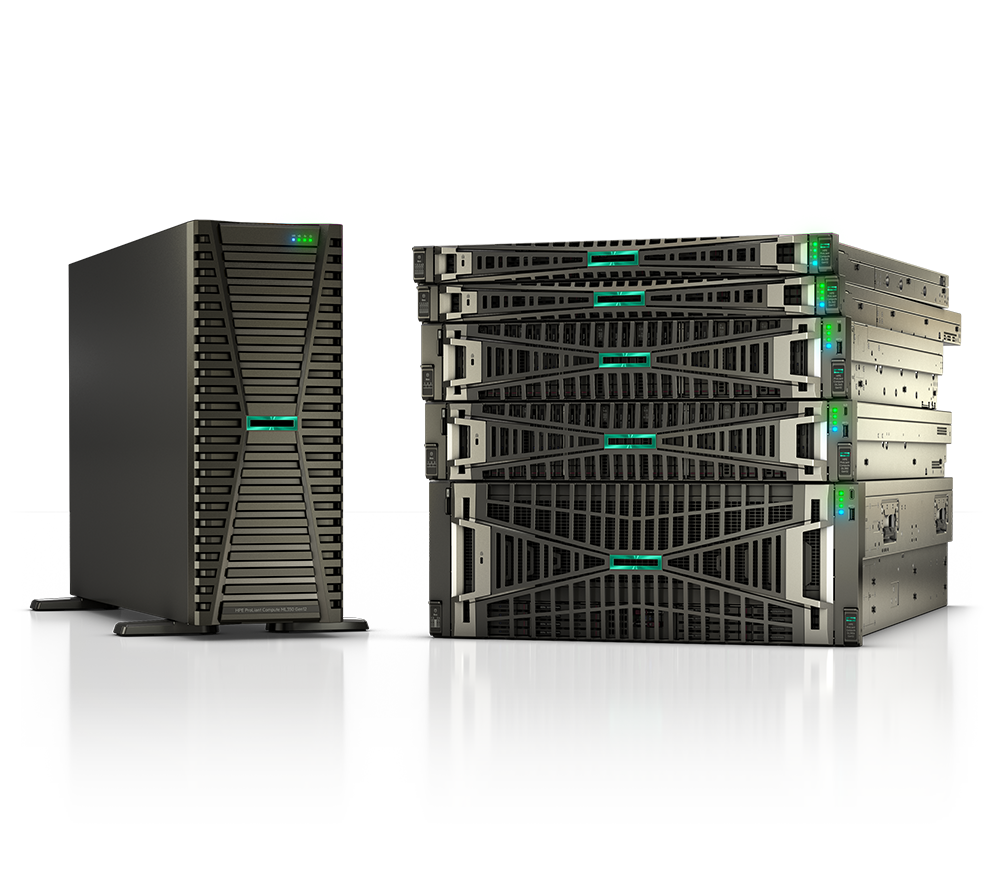
Training gets the headlines, but inference is where most enterprises actually spend their AI budget. Once a model is in production, it runs every hour of every day, and the AI inference hardware underneath it has to deliver predictable latency, keep GPUs busy, and stay inside a budget that finance will sign off on. This is exactly the problem HPE ProLiant Gen12 GPU servers are built to solve, and below are reference configurations that scale from a single pilot node to a full inference fleet.
Why inference infrastructure is its own design problem
Inference workloads behave differently from training. They are latency-sensitive, often spiky, and frequently constrained by GPU memory rather than raw FLOPS. A 70-billion-parameter model serving real users needs enough VRAM to hold weights and KV cache, fast storage to feed retrieval-augmented generation (RAG) pipelines, and networking that does not become the bottleneck under concurrent requests.
Buying training-class clusters for inference wastes money. Buying undersized nodes forces premature re-platforming. The goal of any AI inference HPE design is to right-size the GPU, memory, and storage tier to the models you actually run, then leave a clear path to add capacity as request volume grows.
The HPE ProLiant Gen12 approach to AI inference
HPE's Gen12 generation pairs Intel Xeon 6 processors with NVIDIA accelerators in chassis tuned for accelerated computing. Two platforms anchor most enterprise AI infrastructure builds:
- HPE ProLiant Compute DL380a Gen12 — a 4U, dual-socket server supporting NVIDIA H100 NVL, H200 NVL, and L40S GPUs. HPE submissions on this platform topped multiple MLPerf Inference: Datacenter v5.0 tests, including Llama2-70B and GPT-J. The H200 NVL roughly doubles inference throughput versus H100 on memory-bound models thanks to its larger, faster HBM.
- HPE ProLiant Compute DL384 Gen12 — built around the NVIDIA GH200 NVL2 superchip, delivering up to 3.5x the GPU memory capacity and 3x the bandwidth of a single H100 server. This is the platform when a single model is too large or memory-hungry for discrete cards, or when KV cache for long context windows dominates.
Feeding those GPUs matters as much as the GPUs themselves. HPE Alletra Storage MP X10000 is NVIDIA-Certified for enterprise AI and integrates with the NVIDIA AI Data Platform, so RAG and vector pipelines get the IOPS and metadata handling they need to keep GPU utilization high instead of leaving expensive accelerators idle waiting on data. For teams that want the whole stack pre-validated, HPE Private Cloud AI is a turnkey AI factory co-engineered with NVIDIA that bundles compute, storage, and the AI software layer.
Reference GPU server configurations that scale
Use these as starting points, then tune GPU count and memory to your model sizes. Always confirm current SKUs and GPU availability at quote time.
| Tier | Platform | GPU configuration | Best-fit inference workload | Storage pairing |
|---|---|---|---|---|
| Pilot / departmental | DL380a Gen12 | 2x NVIDIA L40S | Smaller LLMs, vision, classic ML, dev/test | Local NVMe |
| Production LLM | DL380a Gen12 | 4x NVIDIA H100 NVL or H200 NVL | 7B-70B chat/RAG with concurrent users | Alletra MP X10000 |
| Memory-bound / long context | DL384 Gen12 | NVIDIA GH200 NVL2 | Large models, long context, heavy KV cache | Alletra MP X10000 |
| Fleet / multi-tenant | Multiple DL380a/DL384 + Private Cloud AI | Mixed H200 / GH200 | Multiple models, agentic AI, governed serving | Alletra MP X10000 cluster |
The pattern is deliberate: start on a single node sized to your largest current model, standardize on one or two chassis types so spares and operations stay simple, and scale out horizontally rather than rebuying. A pilot on an L40S node can validate your serving stack before you commit to H200 or GH200 capacity.
How to choose the right GPU server configuration
Work through these questions in order before you finalize a build:
- What is your largest model's memory footprint? Sum model weights plus KV cache at your target context length and concurrency. If it exceeds what discrete GPUs hold comfortably, move to GH200 (DL384).
- Is the workload latency- or throughput-bound? Interactive chat prioritizes low latency per request; batch document processing prioritizes tokens per second. This drives GPU count and batching strategy.
- How data-hungry is the pipeline? RAG and agentic workloads hammer storage. Pair GPU nodes with NVIDIA-Certified Alletra rather than relying on local disk.
- What is your growth curve? If request volume is doubling every quarter, standardize on a chassis you can replicate and consider HPE Private Cloud AI for unified scaling and governance.
- What are the facility constraints? GPU nodes are dense. Confirm rack power, cooling, and weight before ordering, especially in older SLED or healthcare data centers.
Outcomes enterprises see
Right-sized AI inference infrastructure produces measurable results: higher sustained GPU utilization (you paid for the silicon, so keep it busy), predictable tail latency for end users, and a capacity model that scales by adding nodes instead of forklift upgrades. Pairing GPUs with certified storage is the lever that most often moves utilization, because idle GPUs waiting on data are the most expensive waste in any AI budget.
How Uniqcli helps
Uniqcli is an authorized HPE, HPE Aruba Networking, and HPE Juniper Networking reseller, and we scope, quote, and deliver complete AI inference stacks, not just boxes. That means sizing the right ProLiant Gen12 GPU server against your actual models, pairing it with Alletra storage and the networking fabric to match, and validating power and cooling before anything ships.
For public-sector and regulated buyers, we handle procurement through the vehicles you already use: TAA-compliant hardware, GSA Schedule, SEWP, and E-Rate where applicable, with quoting that maps cleanly to your contract and budget cycle. Browse current options in our catalog, compare platforms side by side on /compare, or explore configured systems under /products. When you are ready for firm pricing and lead times, request a quote and we will turn around a right-sized configuration with deployment and lifecycle support included.
FAQ
What is the best HPE ProLiant GPU server for AI inference? For most enterprise inference, the HPE ProLiant DL380a Gen12 with NVIDIA H200 NVL GPUs offers the strongest balance of throughput, memory, and cost. For very large or long-context models, the DL384 Gen12 with NVIDIA GH200 NVL2 provides far more GPU memory and bandwidth in a single node.
Do I need special storage for AI inference, or is local disk enough? A pilot node can run on local NVMe, but production RAG and agentic pipelines benefit from NVIDIA-Certified HPE Alletra Storage MP X10000, which keeps GPUs fed and utilization high. Idle GPUs waiting on slow storage are the most expensive inefficiency in an AI deployment.
Can I buy HPE AI infrastructure through government contract vehicles? Yes. Uniqcli supplies TAA-compliant HPE AI infrastructure and can quote through GSA, SEWP, and E-Rate where eligible. Request a quote and we will align the configuration to your contract.
How do I avoid overbuying GPU capacity? Size to your largest current model, standardize on one or two chassis types, and scale out by adding nodes rather than over-provisioning upfront. Starting with a single right-sized node and a clear growth path is far more cost-effective than buying training-class clusters for inference work.