
HPE and Aruba Networking in 2026: Trends Buyers Should Watch
The enterprise networking market is moving faster in 2026 than it has in years. Two catalysts are driving that pace: HPE's completed integration of Juniper Networks and the relentless pressure from AI workloads that demand more bandwidth, lower latency, and far greater operational intelligence than traditional networks can deliver. For organizations running HPE or Aruba infrastructure — or evaluating it — understanding where the platform is heading is no longer optional background knowledge. It directly shapes procurement cycles, refresh timelines, and support contracts.
Whether you are managing a campus network for a university health system, building out a federal data center, or planning a multi-site SLED deployment, 2026 brings a set of concrete shifts worth tracking. This post breaks down the hpe networking trends 2026 buyers should follow, grounded in what HPE has actually announced — not speculation.
The Juniper Integration Is Real, and It Changes the Platform Roadmap
HPE closed its $14 billion acquisition of Juniper Networks in 2025, and by early 2026 the integration had moved from organizational to technical. The strategy HPE describes as "build once, deploy twice" means shared AI capabilities, common hardware, and coordinated roadmaps across HPE Aruba Networking Central and HPE Juniper Mist — without collapsing the two into a single product.
For buyers, the practical implication is that neither platform is being sunset. HPE confirmed at MWC 2026 that both Aruba Central and Mist will receive active investment through at least 2028. What is changing is the depth of cross-pollination:
- Marvis Actions — the AI-driven remediation engine from Juniper Mist — is now available inside HPE Aruba Central, bringing autonomous wired and wireless fault resolution to Aruba customers.
- Aruba's Agentic Mesh anomaly detection and root-cause reasoning engine is moving to the Mist platform.
- Mist's Large Experience Model (LEM), which uses telemetry from applications like Zoom and Microsoft Teams to detect video quality degradation before users report it, is being extended to Aruba Central subscribers.
The partner program consolidation follows on November 1, 2026, when HPE Partner Ready Vantage absorbs both the Juniper and Aruba partner tracks. Organizations that have long-standing Aruba channel relationships should confirm with their reseller how that transition affects their support and pricing agreements.
Self-Driving Networks: From Marketing Language to Shipping Features
"Self-driving network" has been HPE's aspirational framing for several years. In 2026, it describes features that are actually shipping. HPE's May 2026 announcement expanded autonomous actions across both platforms; the June 2026 HPE Discover conference extended those capabilities further across edge, campus, data center, and AI factory environments.
Specific autonomous capabilities now available in HPE Aruba Central include:
- Wired port remediation — the platform identifies a failing or misconfigured port and remediates it without a ticket being opened.
- Dynamic Capacity Optimization — autonomous RF tuning that adjusts band selection, channel bandwidth, and transmit power based on learned utilization patterns, going beyond the static limits of traditional RF management.
- Client roaming insights — visual recreation of a client's roaming path across a floor plan, with AP handoff simulation to identify where delays or failures occur.
- AI data center features using agentic reasoning to accelerate root cause analysis in data center switching environments.
These are not experimental features behind a feature flag. They are part of the standard HPE Aruba Central subscription and the HPE Aruba Networking Central On-Premises 3.0 release, which brings the same AIOps capabilities to customers who cannot use cloud-managed infrastructure — a critical distinction for federal and classified environments.
AI Workloads Are Reshaping the Switching Portfolio
The most consequential hardware story in 2026 is the expansion of the HPE networking portfolio to support AI infrastructure — specifically the high-bandwidth, low-latency, lossless fabric requirements of GPU clusters and inference endpoints.
At HPE Discover 2026, HPE announced several new switches oriented around AI workloads:
- The QFX5140 — a switch targeting inference clusters and edge AI deployments.
- The QFX5252 switch tray, designed specifically for AMD Helios rack-scale systems.
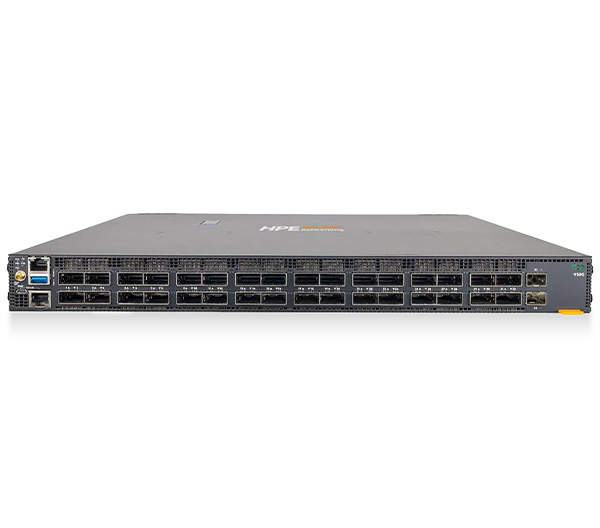
- The CX 10040 distributed services switch, which delivers 8 Tbps of non-blocking switching capacity and includes four DPUs for inline security processing.
For campus and branch environments, the Aruba CX 6300M series refresh brought faster data speeds, compact form factors suited to dense IoT and device-heavy environments, and tighter integration with HPE Aruba Central's AIOps pipeline.
Buyers evaluating switching infrastructure for AI or high-performance computing workloads should assess not just port speed and density but also the management integration story — specifically whether the switch feeds telemetry into the same AIOps plane that manages their wireless and SD-WAN environment. HPE's pitch is that a unified telemetry layer reduces mean time to resolution across the stack. You can explore the current switching lineup at Uniqcli's HPE networking products page.
Wi-Fi 7 Is Now the Campus Standard
Wi-Fi 6E deployments are still in progress at many organizations, but the HPE Aruba product roadmap has moved decisively to Wi-Fi 7. The 750 Series, 740 Series, and 720 Series campus access points are all Wi-Fi 7 hardware, and new outdoor and specialized variants have followed.
What differentiates HPE's Wi-Fi 7 implementation from a simple standards upgrade:
- The 750 Series delivers up to 18.7 Gbps aggregate tri-band throughput and is engineered to go beyond the baseline Wi-Fi 7 specification, with enhanced 6 GHz band utilization and multi-link operation.
- Built-in IoT radio support allows the same AP to serve as the control point for Zigbee, Bluetooth Low Energy, and other protocols — reducing the need for separate IoT gateway hardware.
- Location-aware capabilities are embedded in the hardware, enabling real-time asset tracking without a separate overlay system.
For healthcare buyers, the combination of high-capacity wireless, embedded IoT support, and asset location services in a single managed platform addresses several distinct operational requirements simultaneously. For education and SLED buyers, the Wi-Fi 7 access points can be procured and managed through HPE GreenLake for Networking, spreading capital cost into a predictable operating expense. If you are planning a wireless refresh, the Uniqcli networking catalog includes the full 750, 740, and 720 Series access point lines.
Unified SASE and Zero Trust Are Now Table Stakes
Security is no longer an add-on conversation in networking procurement — it is part of the initial architecture discussion. HPE Aruba Networking's unified SASE platform combines SD-WAN with a full Security Service Edge (SSE) stack that includes:
- Zero Trust Network Access (ZTNA) for identity-based, least-privilege access to applications
- Secure Web Gateway (SWG) for outbound traffic inspection
- Cloud Access Security Broker (CASB) for SaaS visibility and control
- Data Loss Prevention (DLP) integrated into the cloud-delivered policy engine
- Digital Experience Monitoring (DEM) for end-to-end application performance visibility
When combined with HPE Aruba ClearPass Network Access Control, the platform enforces zero trust policy across wired, wireless, and WAN connections — including unmanaged and IoT devices that cannot run a software agent.
In March 2026, HPE announced expanded threat intelligence capabilities that incorporate additional networking telemetry to deliver real-time, AI-native threat insights, converting threat data into actionable enforcement faster. For federal and SLED buyers operating under frameworks like NIST 800-207 or OMB M-22-09, this integrated approach simplifies the architectural justification for zero trust adoption because the enforcement points are built into the network infrastructure rather than requiring a separate overlay.
| Capability | HPE Aruba Unified SASE | Traditional Network + Bolt-on Security |
|---|---|---|
| SD-WAN | Integrated | Separate appliance or overlay |
| ZTNA | Integrated, cloud-delivered | Third-party, often agent-dependent |
| SWG / CASB | Integrated | Separate vendor and contract |
| IoT policy enforcement | Via ClearPass NAC | Typically unsupported or manual |
| AI-driven threat insights | Native, telemetry-fed | Requires SIEM integration |
| Management plane | Single (Aruba Central) | Multiple consoles |
Organizations comparing vendors on a pure feature-count basis will find many competitors check similar boxes. The differentiation with HPE Aruba is the degree to which the security and networking planes share a management interface, a policy engine, and a telemetry pipeline — reducing both operational complexity and the surface area for misconfiguration.
GreenLake NaaS Makes Enterprise Networking Accessible to Constrained Budgets
Capital expenditure constraints are a persistent reality in SLED, healthcare, and mid-market enterprise. HPE GreenLake for Networking addresses this directly by packaging hardware, software, management, and support into a monthly subscription with fixed payments over three- and five-year terms.
The 2026 GreenLake networking service packs are structured around common deployment patterns — wired campus, wireless, SD-WAN, data center switching — with a single SKU designed for repeatable deployment. Key advantages for budget-constrained buyers:
- No upfront hardware capital outlay — equipment is HPE-owned, deployed at the customer's site.
- Always-current software — subscription terms include software updates and AIOps management through Aruba Central.
- Scalable capacity — service packs allow organizations to align network spend to actual usage needs rather than locking in capacity years in advance.
For healthcare organizations managing aging network infrastructure against tight capital budgets, GreenLake NaaS can enable a Wi-Fi 7 upgrade or data center fabric refresh that would otherwise require a multi-year approval cycle. Contact the Uniqcli team to model a GreenLake NaaS scenario for your environment.
The Agentic Enterprise Vision: What Buyers Need to Understand Now
HPE Discover 2026 in Las Vegas centered heavily on the concept of the agentic enterprise — where AI agents execute multi-step workflows autonomously, and the network must be architected to support their identity, governance, and security requirements. HPE introduced the GreenLake Intelligence Mesh, a framework that assigns identity and governance policies to each AI agent in an enterprise environment, backed by a three-tier identity model and NVIDIA Open Shell for policy-enforced agent runtimes.
For most networking buyers, this vision is directional rather than immediately actionable. But it carries two near-term implications worth noting:
- Network observability and telemetry matter more than ever. AI agents that interact with enterprise systems generate new traffic patterns that traditional monitoring tools are not designed to classify or inspect. Buyers investing in network infrastructure now should confirm their management platform can extend visibility to agent-generated traffic.
- Zero trust architecture is foundational, not aspirational. The governance frameworks HPE is building for agentic AI assume a network where every entity — user, device, or agent — must authenticate and operate under a least-privilege policy. Organizations that delay zero trust adoption now will face greater remediation cost when agentic workloads arrive.
Buying Guidance: Questions to Ask Before the Next Refresh
Given the pace of change in the HPE and Aruba portfolio, buyers entering a refresh or new deployment in the second half of 2026 should pressure-test several assumptions:
- Platform alignment: Are you building on Aruba Central, HPE Mist, or a mixed environment? Clarify how the "build once, deploy twice" integration affects your specific feature set and support path.
- Management model: Cloud-managed, on-premises, or hybrid? HPE Aruba Central On-Premises 3.0 now includes AIOps parity with the cloud platform — an important update for federal and regulated environments.
- AI readiness of the fabric: If GPU infrastructure or inference endpoints are in the three-year plan, evaluate switching for lossless fabric support and telemetry integration today rather than retrofitting later.
- Security consolidation opportunity: A simultaneous network and security refresh — converging SD-WAN, NAC, and SSE onto the HPE Aruba SASE platform — can reduce vendor count and management overhead significantly.
- Consumption model: Compare CapEx purchase through authorized channels against GreenLake NaaS total cost of ownership over a five-year horizon. The math changes significantly depending on refresh cycles and software update requirements.
For a full view of currently available HPE Aruba switches, access points, and management licenses, browse the Uniqcli networking catalog or visit the Uniqcli shop for current SKUs and pricing.
How Uniqcli Helps
Uniqcli is an authorized HPE and HPE Aruba Networking partner serving federal, SLED, healthcare, and enterprise buyers. We help organizations navigate exactly the decisions outlined above — platform selection, refresh planning, GreenLake NaaS modeling, security architecture review, and competitive comparison.
If you are evaluating HPE or Aruba networking infrastructure for a 2026 or 2027 project, we can provide vendor-honest guidance, current pricing, and configuration support. Request a quote or reach out to the Uniqcli team to start the conversation.