
"Healthcare Network Procurement: Building a HIPAA-Aware Aruba and Juniper Campus"
Healthcare network procurement is unlike any other campus buy. The same network that carries a guest checking email also carries telemetry from an infusion pump, a PACS imaging study moving across the data center, and an electronic health record session governed by HIPAA. Get the design and the procurement vehicle right up front and you build a defensible, auditable network; get it wrong and you inherit flat-network risk that surfaces in your next OCR review or breach. This guide walks hospital IT and procurement teams through HIPAA network design, clinical segmentation, and how to buy a HIPAA-aware Aruba and Juniper campus on compliant terms.
Why healthcare networks need a different design
HIPAA's Security Rule does not mandate specific products, but it does require technical safeguards: access controls, audit controls, integrity protections, and transmission security for electronic protected health information (ePHI). In a hospital, those safeguards have to coexist with a device population that is uniquely hard to secure. Connected medical devices — the Internet of Medical Things (IoMT) — include infusion pumps, patient monitors, imaging modalities, and clinical sensors that often run unpatched embedded operating systems and cannot host endpoint agents.
The practical answer is segmentation backed by identity. Rather than trusting a device because it is plugged into a wall jack, the network identifies what each device is, assigns it a role, and confines it to only the resources that role needs. That is the core of a defensible HIPAA network design, and it is where the Aruba and Juniper portfolios inside HPE fit together.
The HIPAA-aware reference architecture
A modern hospital campus typically combines four layers:
- Access and wireless. Aruba CX switches at the access layer with Wi-Fi 7 access points for clinical and patient-facing coverage. Power-over-Ethernet budget matters here because clinical APs, IP phones, and cameras all draw from the same switches.
- Network access control (NAC). Aruba ClearPass Policy Manager authenticates and profiles every endpoint. ClearPass Device Insight uses machine learning to fingerprint IoMT devices by behavior — traffic destination, communication frequency, and attributes — so an infusion pump is recognized as an infusion pump even when it cannot announce itself.
- Dynamic segmentation. Policy follows the device. Aruba Dynamic Segmentation lets the same policy apply whether a device connects on wired or wireless, isolating clinical, guest, corporate, and IoMT traffic without re-cabling. A flagged or out-of-date device can be dropped into a restricted VLAN automatically.
- Routing, WAN, and edge security. Juniper SRX firewalls and MX or Session Smart routers handle north-south traffic, inter-VLAN policy enforcement, and the WAN connecting clinics back to the core. Juniper EX switches interoperate with ClearPass for device profiling and segmentation where Junos is the standard.
The result is a network where ePHI lives behind enforced boundaries, every connection is logged for audit controls, and a compromised medical device cannot pivot to the EHR.
How to choose: matching the portfolio to your environment
There is no single right bill of materials. The choice depends on your existing standard (Aruba vs. Juniper management), facility size, and how aggressively you need to segment. Use the table below as a starting selection framework, then validate models and licensing against a live quote.
| Role in the hospital | Recommended platform | Why it fits | Key procurement note |
|---|---|---|---|
| Clinical/campus access switching | Aruba CX 6000/6300 series | Dynamic Segmentation, deep ClearPass integration, PoE/PoE++ for clinical endpoints | Confirm PoE budget against AP and device count |
| Wireless for patient rooms & clinics | Aruba Wi-Fi 7 access points | Capacity and density for telemetry, real-time location, patient devices | Right-size Aruba Central licensing tier (Foundation vs. Advanced) |
| Network access control / NAC | Aruba ClearPass Policy Manager + Device Insight | IoMT profiling, role-based policy, automated quarantine | License by endpoint count; plan a monitor-mode rollout |
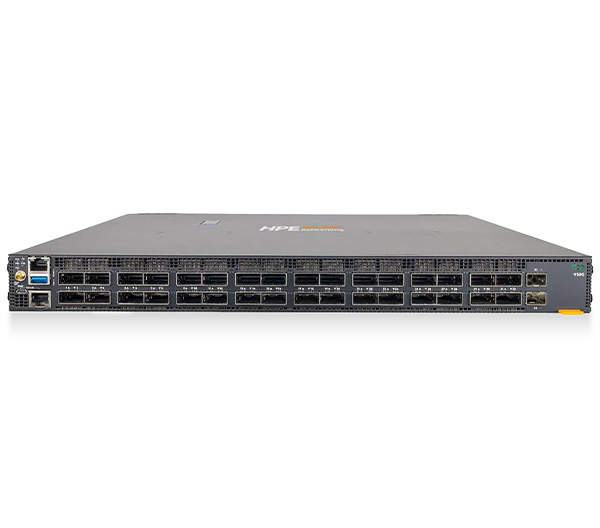
| Data center / segmentation core | Aruba CX 9300/10000 | High throughput; CX 10000 adds in-fabric stateful firewalling for east-west isolation | DPU-based firewalling can reduce separate appliance spend |
| Edge security & WAN | Juniper SRX firewalls; MX or Session Smart routers | NGFW enforcement, inter-VLAN policy, resilient multi-site WAN | Size SRX by threat-inspection throughput and sessions |
| Switching where Junos is standard | Juniper EX series | Interoperates with ClearPass for profiling and dynamic segmentation | Standardize on one cloud manager (Central or Mist) |
A few decision rules that consistently hold:
- Standardize your management plane. Running both Aruba Central and Juniper Mist is possible, but most hospitals are better served picking one cloud manager and aligning the rest of the stack to it. See our Aruba Central vs. Juniper Mist comparison if that decision is still open.
- Buy NAC before you buy more switches. Segmentation is the safeguard auditors care about. ClearPass should be in the first procurement phase, not bolted on later.
- Plan PoE and licensing as line items, not afterthoughts. Under-budgeting PoE or over-buying Central/ClearPass licenses are the two most common cost surprises in healthcare quotes.
Procurement and compliance: TAA, contract vehicles, and verification
Healthcare buyers span federal facilities (VA, DHA), public health systems, academic medical centers, and private hospital networks — and each has different procurement levers.
- Trade Agreements Act (TAA) compliance. Federal and many SLED buyers require TAA-compliant hardware, meaning the product is made or substantially transformed in the U.S. or a designated country. HPE, Aruba, and Juniper offer TAA-compliant SKUs and support; the compliant part number and country of origin must be verified per line item, not assumed across a family.
- Federal contract vehicles. Governmentwide options include NASA SEWP (a GWAC carrying HPE compute, storage, and Aruba and Juniper networking) and GSA Multiple Award Schedule. Army buyers may use ITES-4H. Products listed on these vehicles have already been reviewed for compliance, which shortens the path for federal health systems.
- SLED and education. State, local, and academic medical centers can move faster through cooperative contracts (OMNIA Partners, Sourcewell, NASPO ValuePoint), and university-affiliated hospitals may have E-Rate-adjacent funding for eligible campus networking.
Whatever the vehicle, the audit-friendly move is to keep configuration, TAA attestation, and warranty SKUs documented at quote time so they are ready when compliance asks.
How Uniqcli helps
Uniqcli is an authorized HPE, HPE Aruba Networking, and HPE Juniper Networking reseller, and we scope healthcare networks end to end. That means we help you translate a HIPAA network design into an accurate bill of materials — access switching, Wi-Fi 7, ClearPass NAC, CX 10000 in-fabric firewalling, and Juniper SRX/MX edge — sized to your facility and device population rather than a generic template.
On procurement, we quote on the vehicle that fits you: TAA-compliant configurations for federal health systems, NASA SEWP and GSA ordering, SLED cooperative contracts, and E-Rate-eligible items for academic medical centers. We verify TAA country-of-origin and warranty SKUs at the line-item level so your compliance file is clean. Browse the product catalog to start scoping, compare platforms when you are deciding between Aruba and Juniper, or request a quote and we will turn around a configured, compliant bill of materials with deployment and support options — including a phased ClearPass rollout so enforcement never breaks patient care.
FAQ
Does HIPAA require network segmentation? HIPAA does not name segmentation explicitly, but its Security Rule requires access controls, audit controls, and transmission security for ePHI. Segmentation backed by NAC is the most practical, auditable way to satisfy those technical safeguards in a hospital with mixed clinical and IoMT devices.
How does Aruba ClearPass secure medical devices that cannot run security agents? ClearPass and Device Insight profile devices by behavior and attributes rather than relying on an installed agent. An IoMT device is identified, assigned a role, and confined by dynamic segmentation. If it is flagged as high-risk or running outdated firmware, it can be moved automatically into a restricted VLAN.
Can we mix Aruba and Juniper in the same healthcare campus? Yes. Juniper EX switches and SRX/MX edge devices interoperate with ClearPass for device profiling and dynamic segmentation, so you can keep a Junos standard where it exists while using Aruba for NAC and wireless. We recommend standardizing on a single cloud management platform to keep operations simple.
Are HPE, Aruba, and Juniper products TAA compliant for federal hospitals? Specific TAA-compliant SKUs exist across all three lines, and they are available on vehicles like NASA SEWP and GSA that have already vetted compliance. Compliance must be confirmed per part number and country of origin, which Uniqcli verifies when we build your quote.