
What Is HPE GreenLake? Pay-Per-Use Infrastructure Explained
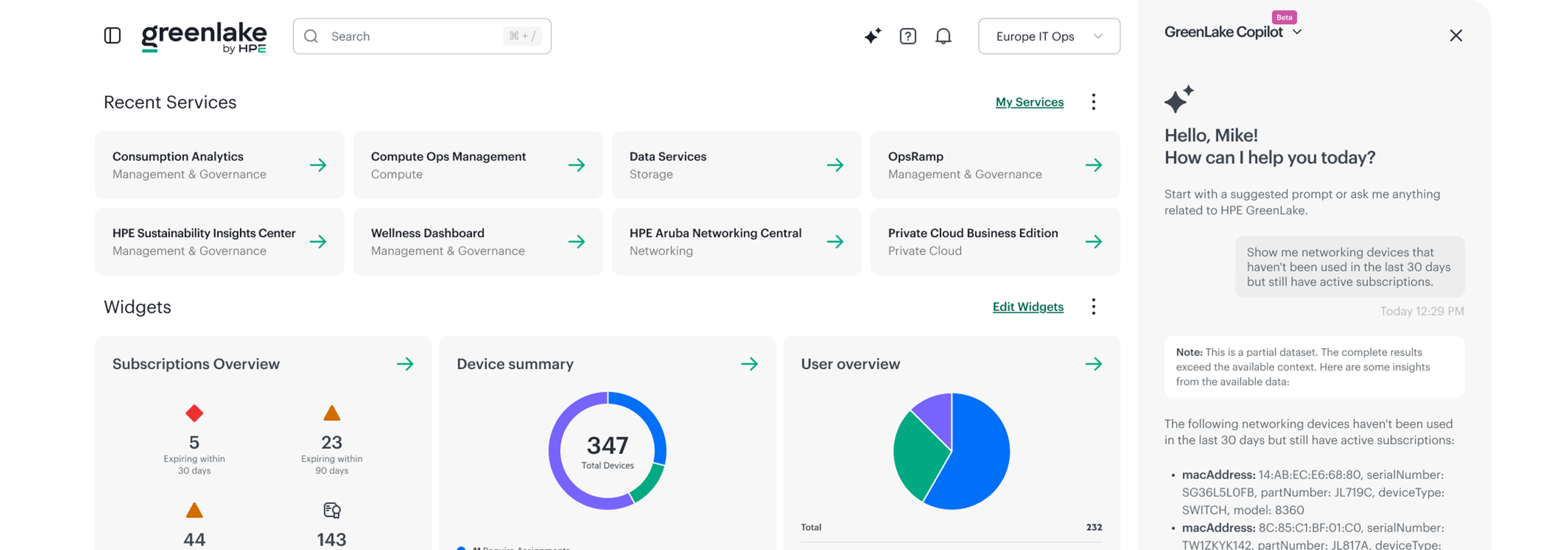
HPE GreenLake is Hewlett Packard Enterprise's flagship edge-to-cloud platform that delivers on-premises infrastructure with a public cloud consumption experience. Instead of forcing organizations to choose between owning capital-intensive hardware outright or migrating sensitive workloads to a hyperscaler, GreenLake offers a third path: enterprise-grade compute, storage, and networking deployed on your premises — or at a colocation facility — and billed monthly based on what you actually use.
For federal agencies, SLED institutions, healthcare networks, and regulated enterprises, this model carries particular weight. Data sovereignty requirements, strict compliance mandates, and long procurement cycles make pure public cloud adoption difficult. GreenLake lets these organizations move to a cloud-like operating model without surrendering control over where data lives or who can access it. With more than 44,000 customers and roughly $2 billion in annual recurring revenue as of HPE's fiscal 2025 reporting, GreenLake is no longer a niche offering — it is the strategic center of HPE's go-to-market strategy.
How the Pay-Per-Use Model Actually Works
The term "pay-per-use" can mean different things depending on the vendor. With HPE GreenLake, the mechanics are specific and worth understanding before you sign a contract.
HPE — or an authorized partner like Uniqcli — installs infrastructure at your site. A committed minimum is set at contract time, representing the baseline capacity you agree to pay for regardless of consumption. Above that floor, usage is metered monthly: sensors and software agents collect telemetry on actual utilization, and those numbers feed into your monthly invoice.
Critically, HPE pre-installs a buffer of additional capacity beyond your committed minimum — typically 20–30% overhead — that sits ready to absorb demand spikes. You do not pay for the buffer until you consume it. As buffer is consumed, HPE works with you on a capacity forecast to replenish it, giving both parties lead time before you run out of headroom.
The three levers that determine your bill each month are:
- Committed capacity charge — the floor you locked in at contract signing
- Variable consumption charge — usage above the committed minimum, metered and billed per unit (vCPU-hours, TB consumed, etc., depending on the service)
- Buffer replenishment — ordered as consumption trends upward, following an agreed change-management process
This structure eliminates the classic on-premises trap of buying peak capacity upfront and watching most of it sit idle. It also avoids the unpredictable egress fees and variable billing surprises that come with hyperscaler public cloud.
GreenLake Flex Solutions vs. Platform Services
HPE organizes GreenLake into two broad delivery tracks, and choosing the right one matters.
GreenLake Flex Solutions is the more customizable track. You select HPE hardware — ProLiant compute, Alletra storage, Aruba networking — configure it to your workload requirements, and HPE delivers it as a consumption service. This track suits organizations with unique workload profiles, existing HPE investments, or custom software stacks that do not fit a pre-packaged cloud template.
GreenLake Platform Services (sometimes called Private Cloud AI or Private Cloud Business Edition) are fully productized cloud services built on GreenLake infrastructure. These include:
- HPE Private Cloud Business Edition — virtualized workloads on vSphere or KVM with a cloud-style self-service portal
- HPE Private Cloud AI — GPU-accelerated infrastructure for AI/ML training and inference, delivered as-a-service
- HPE GreenLake for Storage — powered by the HPE Alletra Storage MP portfolio, including block, file, and object tiers
- HPE GreenLake for Networking — Aruba Central-managed campus and data center networking consumed as a service
- HPE GreenLake for Data Protection — HPE StoreOnce-backed backup and recovery with optional cloud-tiering
Both tracks are managed through HPE GreenLake Central, a unified web console that shows inventory, consumption dashboards, service health, and cost allocation across your entire GreenLake estate — whether that spans one data center or a dozen edge locations.
GreenLake Intelligence: The AIOps Layer
At HPE Discover 2025, HPE announced GreenLake Intelligence, an agentic AI framework embedded directly into the GreenLake platform. This is a significant architectural move that distinguishes GreenLake from simple as-a-service reselling.
GreenLake Intelligence deploys a mesh of specialized AI agents — each trained on a specific infrastructure domain — that collaborate to manage the full IT stack. Agents are available for:
- Observability — continuous telemetry ingestion and anomaly detection
- Root-cause analysis — correlating events across compute, storage, network, and virtualization layers
- Capacity planning — forecasting demand curves and recommending buffer replenishment
- FinOps — surfacing cost inefficiencies and suggesting right-sizing actions
- Sustainability — tracking carbon and energy metrics against organizational targets
- Security and resiliency — monitoring compliance posture and triggering remediation workflows
The agents communicate using the Model Context Protocol (MCP), gather telemetry from the customer environment, and combine it with HPE's domain knowledge base. Users interact via natural language in GreenLake Central. The intent is to move from reactive IT operations — where humans diagnose alerts after the fact — to proactive, and eventually autonomous, operations where agents resolve issues before they become outages. GreenLake Intelligence began rolling out in Q3 2025 and continued expanding through the end of calendar year 2025.
HPE's OpsRamp platform underpins the operations copilot capability, providing AI/ML-based alert correlation, incident management, and multi-domain root-cause assistance across hybrid estates that include third-party infrastructure alongside HPE gear.
HPE GreenLake vs. Public Cloud vs. Traditional CapEx
Understanding where GreenLake fits requires an honest comparison across three procurement models.
| Dimension | Traditional CapEx | Public Cloud (AWS/Azure) | HPE GreenLake |
|---|---|---|---|
| Location | On-premises | Vendor data centers | On-premises or colo |
| Data sovereignty | Full control | Varies by region | Full control |
| Billing model | Large upfront purchase | Variable, per-second metering | Monthly consumption + committed floor |
| Scaling speed | Slow (procurement cycles) | Immediate | Weeks (buffer replenishment) |
| CapEx / OpEx | CapEx | OpEx | OpEx |
| Management overhead | High (IT team owns all ops) | Shared responsibility | Shared or fully managed |
| Compliance controls | Customer-defined | Hyperscaler compliance posture | Customer-defined, on-site |
| Best fit | Predictable, stable workloads | Variable, cloud-native workloads | Sensitive data, hybrid workloads, regulated sectors |
AWS Outposts provides a useful contrast: Outposts brings AWS-native services to an on-premises rack, but the underlying infrastructure remains AWS property, managed by AWS teams, and tied to the AWS service catalog. GreenLake keeps HPE hardware under the customer's physical and logical control; you run whatever software stack you choose. If your organization has made long-term commitments to VMware, SAP HANA, Oracle, or custom HPC software, GreenLake accommodates those workloads without forcing a re-platform.
The honest limitation of GreenLake is that it cannot match a hyperscaler's breadth of managed services or the instantaneous, infinite elasticity of a true public cloud. If your workloads are already cloud-native, bursty, and have no data residency requirements, AWS or Azure may simply be the better fit.
Compliance and Security Architecture
For Uniqcli's core customer verticals — federal agencies, state and local governments, K-12 and higher education, and healthcare networks — compliance is not a checkbox; it is a precondition for deployment. GreenLake addresses this at several levels.
Silicon-level security is built into HPE ProLiant servers via HPE Silicon Root of Trust, which cryptographically binds firmware to a hardware anchor at the silicon level, preventing malicious firmware from executing even if the management plane is compromised. HPE Integrated Lights-Out (iLO) extends this protection to out-of-band management.
Zero-trust architecture is a design principle throughout GreenLake. Role-based access controls, identity federation, and micro-segmentation capabilities are available through the platform and its partner integrations.
HPE GreenLake Continuous Compliance is a monitoring service that automates ongoing evaluation of compliance posture across risk tiers. HPE developed the documented processes based on hundreds of cloud transitions across regulated industries including healthcare, finance, and energy. For healthcare customers, this translates directly to HIPAA workload alignment; for federal agencies, it supports NIST SP 800-53 control frameworks.
HPE's public sector go-to-market is supported through distributors like Carahsoft, which lists GreenLake on relevant government contract vehicles, simplifying procurement for agencies with strict acquisition requirements. HPE also offers joint solutions with Equinix Metal for federal agencies that need colocation with network-adjacent connectivity rather than on-site data center deployment.
HPE Zerto integration provides continuous data protection with near-zero recovery point objectives for disaster recovery — a critical capability for healthcare networks subject to HIPAA availability requirements and for federal agencies with continuity-of-operations mandates.
Who Should Consider HPE GreenLake?
GreenLake is not the right answer for every organization. The consumption model requires a minimum contract commitment and works best when there is a sustained, predictable baseline of workload demand. The ideal customer profile includes:
- Organizations with data residency or sovereignty requirements — financial regulators, healthcare covered entities, federal agencies, and state governments that cannot send certain data to a public cloud
- Existing HPE infrastructure environments — organizations already running ProLiant, Alletra, or Synergy have the most immediate ROI because GreenLake can be layered onto existing HPE assets
- Enterprises tired of the CapEx refresh cycle — three-to-five-year hardware refresh budgets are lumpy and hard to predict; GreenLake converts that to a flat monthly operating line
- Organizations planning AI/ML initiatives on-premises — GreenLake for Private Cloud AI delivers GPU clusters as-a-service without forcing a move to a hyperscaler
- IT teams stretched thin on operations — the managed service option and GreenLake Intelligence reduce the operational burden on in-house teams without relinquishing infrastructure control
Organizations that are primarily running cloud-native microservices, have no compliance restrictions on public cloud, and do not have existing HPE infrastructure will likely find less incremental value versus simply using AWS, Azure, or GCP directly.
Procurement and Deployment: What to Expect
GreenLake contracts are typically structured as three-to-five year terms. The process moves through several phases:
- Discovery and sizing — HPE and its authorized partners work with you to model workload requirements, project growth curves, and set the committed minimum and buffer levels
- Proposal and contract — the engagement produces a Statement of Work, a consumption rate card (price per unit of compute, storage, or network consumed), and SLA commitments
- Infrastructure deployment — HPE ships and installs hardware at your site or colocation facility; typical deployment windows range from a few weeks to a few months depending on infrastructure complexity
- Activation and onboarding — GreenLake Central is configured, metering is validated, and the operations team is trained on the portal
- Ongoing lifecycle management — HPE or the partner handles firmware updates, hardware break-fix, and buffer replenishment; the customer manages workloads and data
For federal buyers, GreenLake is available through multiple contract vehicles. SLED buyers can access GreenLake through state-level cooperative purchasing agreements. Uniqcli can help navigate specific vehicle eligibility and assist with the technical sizing that drives the contract.
One detail worth flagging: because GreenLake installs physical hardware on your premises, it requires adequate data center space, power, and cooling. The pre-deployment assessment should include a physical infrastructure review to avoid surprise rack-and-stack delays.
How Uniqcli Helps
Uniqcli is an authorized HPE and HPE Aruba Networking partner with direct experience sizing, procuring, and deploying GreenLake engagements for federal, SLED, healthcare, and enterprise customers. We understand the compliance requirements, the contract structures, and the workload modeling that determines whether GreenLake — and which GreenLake track — is the right fit for your organization.
If you are evaluating GreenLake as a replacement for a CapEx refresh, exploring it for a new AI infrastructure initiative, or simply trying to understand how the consumption billing compares to your current spend, we can model that out for you — no vendor lock-in required in the analysis.
Browse the full HPE GreenLake portfolio on Uniqcli to see available service tiers, or explore our broader infrastructure products catalog for complementary HPE ProLiant and Alletra offerings. You can also review our buyer's guides for related technology decisions across storage, networking, and compute.
Request a quote and let us know your workload type, data sensitivity requirements, and current infrastructure mix. We will come back with a GreenLake sizing model and a realistic total-cost-of-ownership comparison. Or if you prefer a conversation first, reach out to our team — we are happy to talk through the architecture before anything goes on paper.